Soooo, you go to make a visual representation of your dreams and you’re wondering, “Okay…but what vision board categories am I supposed to include?” For a lot of women, the moment scissors come out or a Pinterest board gets created, a quiet pressure sneaks in.
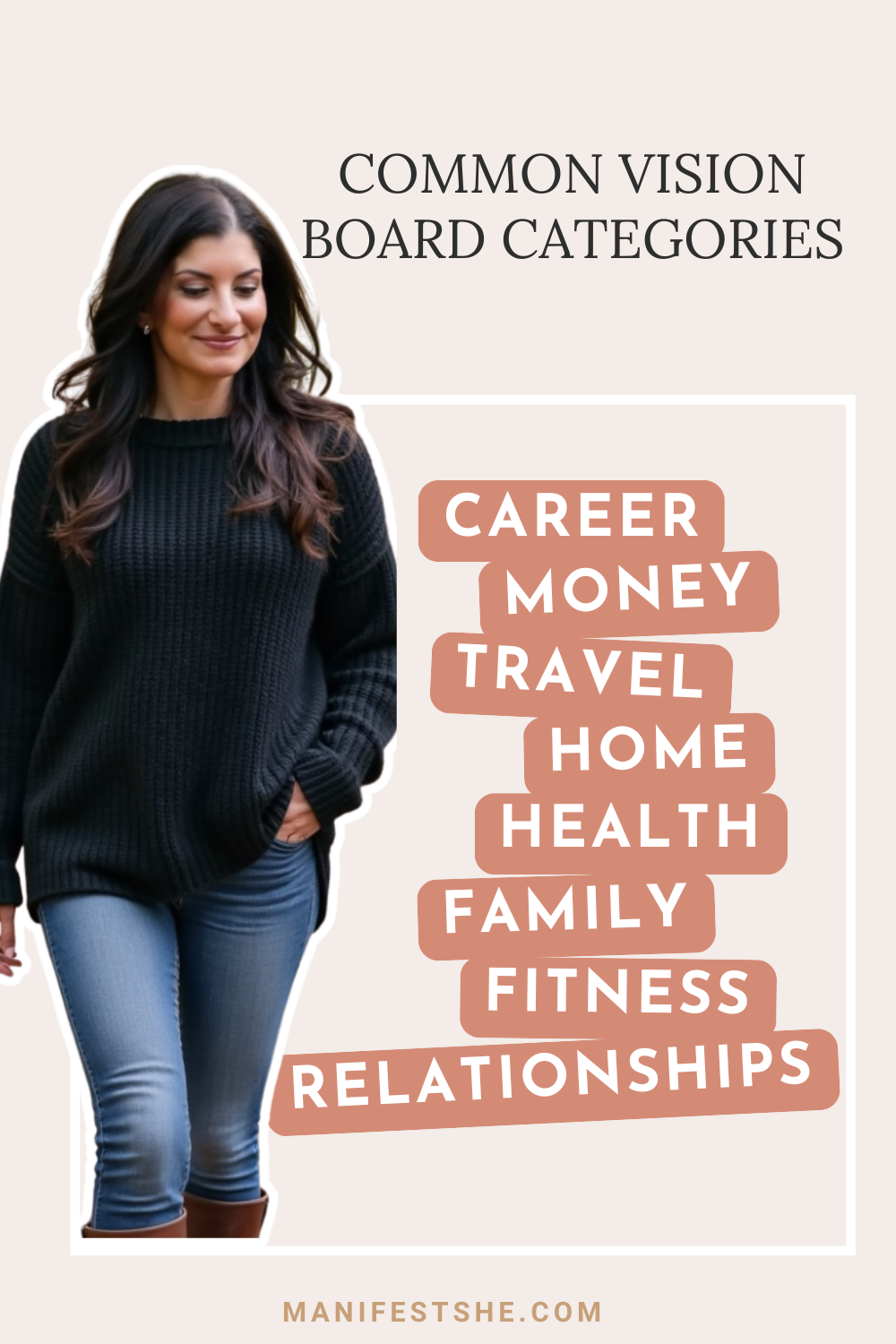
You start thinking about areas of your life. Career. Money. Love. Family. Travel. Health. Home. And suddenly what was supposed to feel expansive turns into another checklist you’re trying to complete correctly.
And if you’ve spent any amount of time online, you’ve probably seen vision board templates, worksheets, or Pinterest graphics telling you that you should fill in each category if you want your vision board to “work.” You set work goals over here. Relationship goals over there. Financial goals in their own lane. And then you’re expected to manage and improve each area independently, as if your life doesn’t overlap in a hundred invisible ways.
And with that overlap in mind, this is what I’ll cover in this post:
- Why vision board categories became popular in the first place
- The hidden problem with separating your life into neat boxes
- How desires actually move your life forward
- A more aligned way to work with your vision board (the Manifest SHE way)
If you’ve ever felt stuck trying to decide what belongs on your board, you’re gonna want to keep reading.
Why Vision Board Categories Became “A Thing”
The idea of vision board categories didn’t come from nowhere. They became popular because they gave structure to something that can feel very open-ended. When someone sits down with a blank poster board and a stack of magazines, categories offer a sense of direction.
They answer questions like:
- What should I focus on?
- How do I know I’m covering everything?
- What if I forget an important area of my life?
So categories like career, money, relationships, and health started being used as a framework to make the process feel more manageable.
On paper, that sounds pretty effective. In practice, it often creates a strange disconnect. Women end up pasting images into categories not because those desires feel alive or urgent, but because the category exists and feels like it needs to be filled. So, a picture of a house goes under “home.” A couple walking on the beach goes under “love.” And a stack of cash or a laptop by a pool goes under “money.”
Presto..your board looks complete. It even looks impressive. But then it just sits there and you don’t ever see the pics become your real life.
The Issue With Treating Life Like Separate Buckets
The problem isn’t that these vision board categories exist. Of course they do. The issue is that they’re treated as separate lanes when, in real life, they rarely are.
Think about money, for example. Money impacts where you live, how you spend your time, the stress you carry in your body, the choices you make in relationships, and the freedom you feel to say no or yes. It’s not just a “money category.” It touches everything.
The same is true for career. Your work affects your schedule, your energy, your confidence, your social circle, and often your sense of identity. Relationships affect your emotional safety, your nervous system, your ability to take risks, and even how much you believe you’re allowed to want.
When you try to isolate these experiences into separate boxes on a board, you’re mapping out your life in an unnatural way. Heck, sometimes it may even lead to confusion like “Is a vision of working from home a career desire, a lifestyle desire, or a family desire?” (Spoiler: The answer is usually “all of the above.”)
But that isn’t the only reason I don’t recommend working in categories…
A Huge Downside to Filling Categories
A GIANT downside of vision board categories is the pressure they create to want things you may not actually want right now. When a category is sitting empty, it can trigger the same kind of discomfort like you forgot something or you are going to end up behind everyone else.
If you don’t have a strong desire around relationships at the moment, the “love” category can feel awkward. If your career feels stable and your focus is elsewhere, the “career” section can feel forced. But maybe you add something anyway, because you think you HAVE to.
This is where vision boards can start working against you instead of for you. Instead of clarifying your true desires, they can subtly train you to override them. You learn to prioritize a completed task over honesty. Compliance to rules over resonance.
The issue isn’t that categories are wrong. It’s that they’re often treated as a requirement instead of a reference point.
How to Approach Vision Boards Differently
The Manifest SHE approach doesn’t start with categories. It starts with desire.
Not the polished, socially acceptable version of desire. But the kind that keeps nudging you when you’re brushing your teeth, scrolling on your phone, or lying awake at night thinking about what you want more of.
Desires don’t arrive labeled. They show up as feelings, images, longings, and “what if” thoughts. They’re often layered, evolving, and interconnected. Trying to sort them into boxes too early can erode them.
Instead of asking, “Which categories should I include?” the more useful question is, “What is alive for me right now?”
When you work this way, your vision board becomes responsive instead of prescriptive. It reflects what you actually want, not what you think you should be focusing on.
Moving Away from the Board
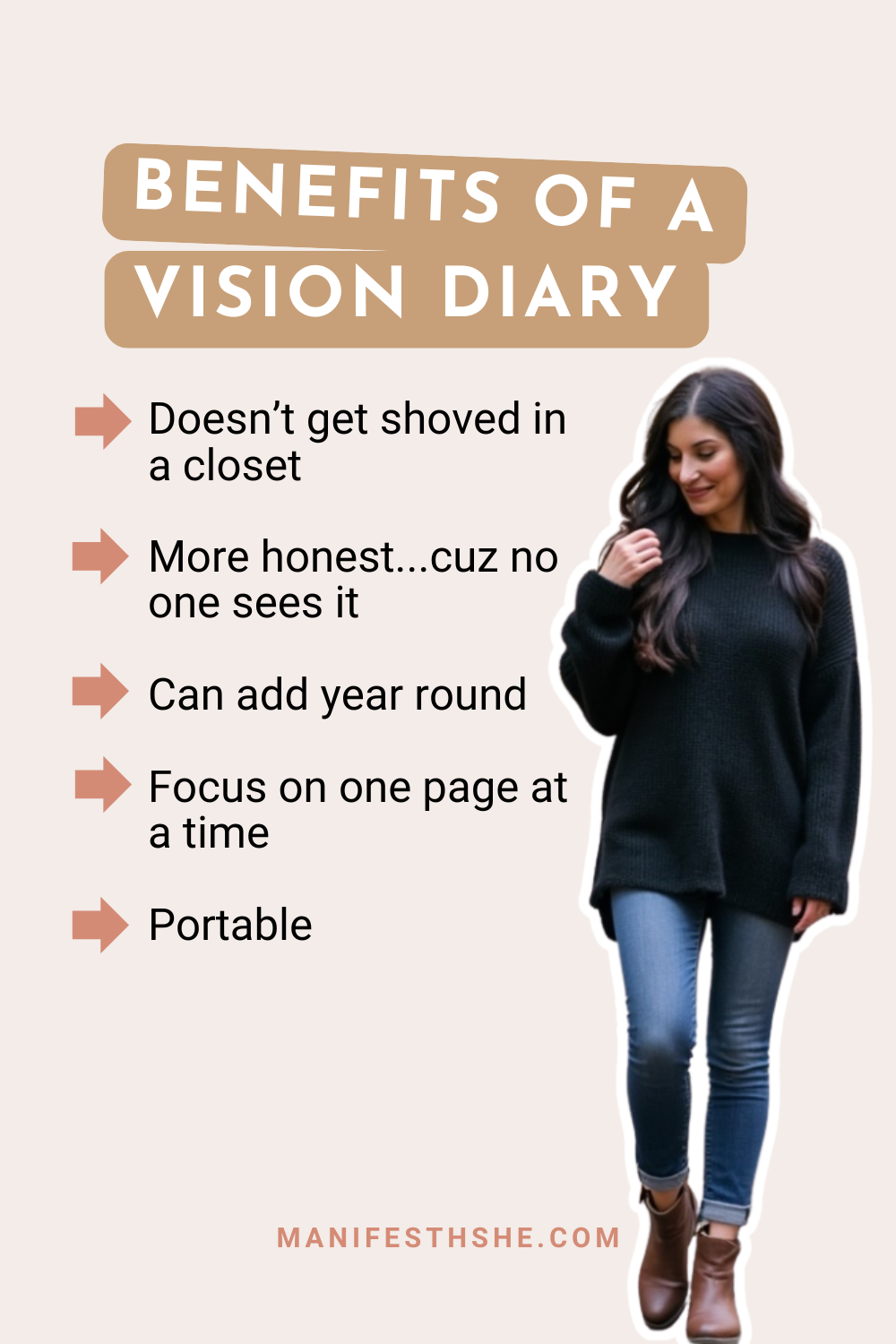
Members of the Manifest SHE Vision Lab work with vision diaries instead of boards to help this process. What once was a bulky board is now an accessible diary. They add to their diary as desires come naturally. Not only that,they work with a page or two at a time so there isn’t that “Oh, no! I have empty space” feeling.
They also don’t have to hang it up, take it down, and hang it back up whenever they want to add to it. Instead, they can just grab it from their dresser or nightstand. Speaking of grabbing, the diary is portable so if they want to look at it they can on the porch in the sun or cozy on their couch with some hot tea.
So, if you were wondering how a board would function without categories, you may want to try your hand at a vision diary instead.
How Results Actually Happen with Vision Boards
This is where it’s important to zoom out for a sec cuz vision boards don’t create change because you’ve checked off the right categories. And no, they don’t create change because you stare at pretty pictures all day. They create change because they influence how you think, feel, and respond to life.
That’s because your beliefs shape roughly 95% of your daily experience. A vision board works when it gently but consistently introduces new possibilities into that belief system.
When your board reflects desires that are meaningful and current, it naturally impacts your internal world. By default you start to think, feel, and act differently. Over time, those shifts compound and now your outer world reflects back to you what happened in your inner world.
When Vision Board Categories Can Be Helpful
All of that said, categories aren’t evil. They can be useful as a loose framework if you enjoy structure or want a way to reflect on your life holistically. The key is how you relate to them.
Instead of treating categories as boxes that must be filled, you can treat them as lenses. You might glance at them and ask, “Is there anything in this area that feels alive for me right now?” If the answer is no, you move on.
You can also let categories emerge after the fact. Sometimes, once a board is created, you’ll notice patterns. You might realize most of your images relate to freedom, ease, or self-expression. That insight can be powerful. It tells you what your prioritizing without you having to decide in advance.
The Bigger Shift: From Managing Life to Living It
At its core, the conversation about vision board categories is really about control. Categories appeal to the part of us that wants to manage life, optimize it, and make sure nothing goes wrong. Desire-led creation appeals to the part of us that wants to live it.
When you stop worrying about whether your board is balanced and start paying attention to what feels true, something softens. You’re no longer trying to fix your life from the outside. You’re allowing it to reorganize from the inside.
That’s where real change happens. Not because you followed the rules, but because you trusted the signals your own system was already sending.
So… Should You Use Vision Board Categories to Get Results?
You can, but you don’t need to. And for many women, letting go of rigid categories is the very thing that allows their vision board to start working.
If categories help you reflect, use them lightly. But if they create pressure, skip them entirely. Your results won’t come from how organized your board looks. They’ll come from how honestly it reflects what you really want in life.
If you’ve been feeling stuck or unsure about your vision board, it’s probably not because you need better categories.
It’s more likely that you need support with:
- Clarifying what you actually want
- Trusting the desires that come up
- Translating your vision into daily life without pressure
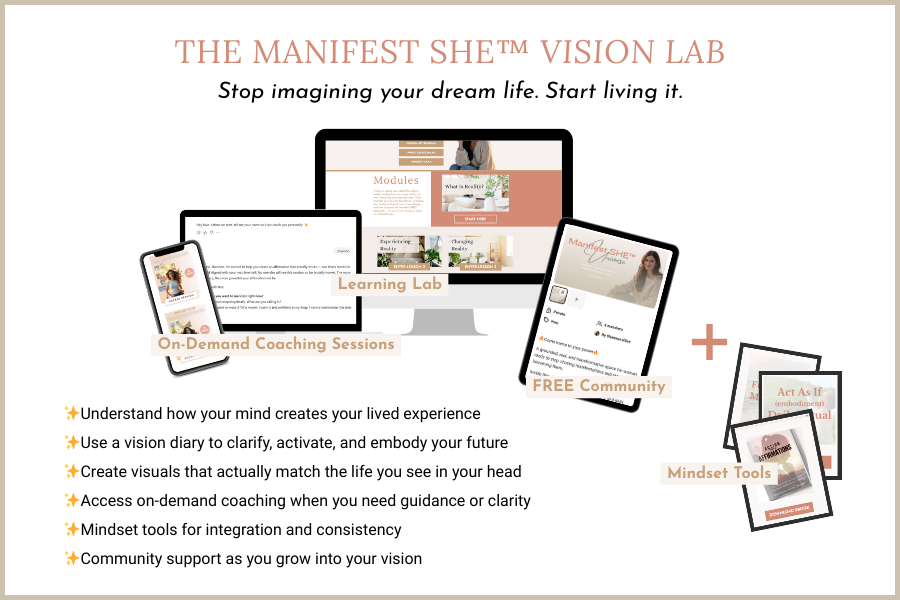
That’s exactly why the Manifest SHE Vision Lab exists.
There’s no pressure to “do it all.” You choose what supports you most in the moment.
If you’re ready to stop stressing about categories and start using your vision board as a real tool for change, you can explore the Manifest SHE Vision Lab HERE.
View comments
Comment