
When people search for offers examples, they’re usually looking for inspiration or something that is going to infuse their bank accounts with a massive influx of cash. This could be a digital product idea, a coaching structure, or any of the other million things floating around the internet right now. And while examples are helpful, they’re just that…examples. Because the offers that actually sell—the ones that feel good, create impact, and don’t burn you out—are created from alignment.
Instead of giving you a surface-level list of things to sell or regurgitating some get rich quick fallacy, I want to walk you through what makes an offer truly powerful. The structure matters, sure. But it’s the energy, delivery method, nervous system capacity, and pricing congruence that determine whether your offer actually works for you.
A brilliant offer on paper can flop if it wasn’t built to match the woman selling it.
What Makes an Offer Work?
You could sell a high-ticket mastermind, a $37 mini-course, or a one-off Voxer session. All of those offers examples are valid formats. But a format alone won’t determine whether your offer works in the long term.
Here’s what you actually need to consider when creating your offer:
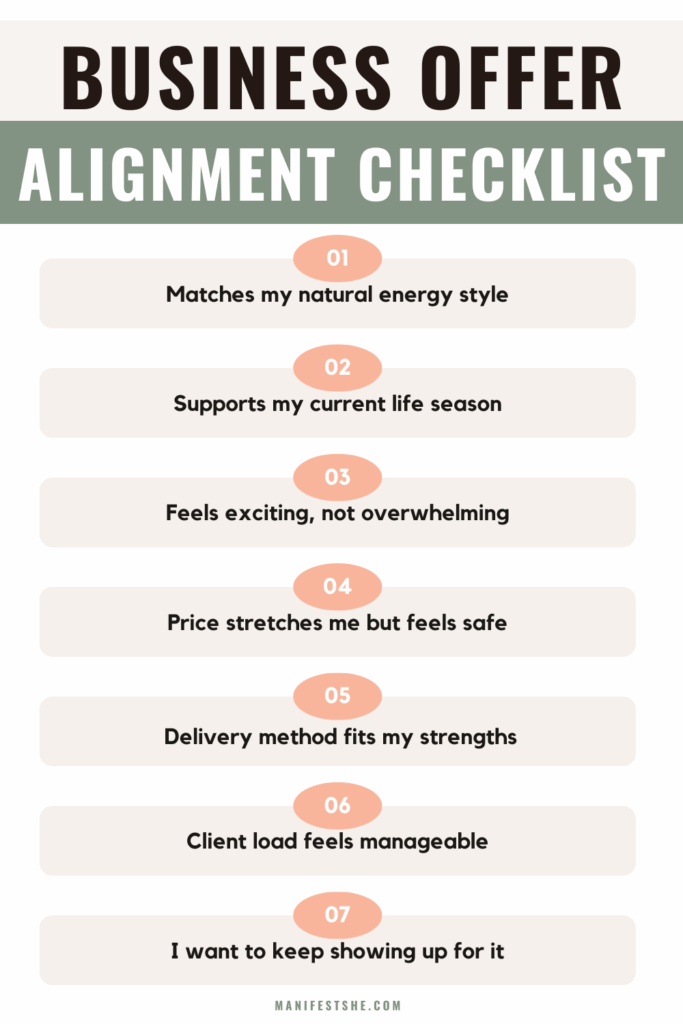
- Your current energy and capacity
- How you like to deliver transformation (teaching, mentoring, hands-on work, behind-the-scenes building)
- What you can energetically hold in terms of client load, pricing, and fulfillment
- Whether your price point matches your nervous system, not just your goals
- If the delivery container supports the transformation you want to offer
These questions go deeper than “what’s trending” or “what’s scalable.” They anchor you into what’s actually sustainable.
Let’s break down the four foundational pieces that shape aligned, effective offers.

Four Core Factors That Make or Break an Offer
Before you decide on the format, name, or price, you need to be brutally honest about what your business and your body can actually hold. These are the real reasons offers thrive or flop behind the scenes.
1. Offer Type vs. Energy Type
This is where so many entrepreneurs get trapped, especially if they’re building off someone else’s offers examples. You see someone succeed with a mastermind or digital product and think, “Oh, I need that too.” But not all formats match all energy types.
If you’re someone who thrives in intimacy and depth, trying to force yourself into high-volume, low-touch offers is going to drain you. Likewise, if you’re lit up by quick bursts of teaching or scalable creation, putting yourself in long-term, high-touch containers might flatten your energy fast.
Ask yourself:
- Does this offer require energy I don’t want to give?
- Am I trying to match someone else’s energy instead of honoring my own?
You don’t need to be a different kind of woman to create a profitable offer. You just need to create the offer that matches your energetic rhythm.
2. Capacity Blind Spots for Offers
This is where we ignore reality and call it ambition. You want the recurring revenue, the big launch, the stacked calendar…until you realize you’re not emotionally, physically, or energetically available to deliver what you sold.
Capacity is not just your time. It’s your nervous system, your emotional resilience, your current life demands. And if you build an offer that requires you to be superhuman to fulfill it, you’ll either under-deliver or burn out.
This doesn’t mean what you have to offer isn’t badass. Of course what you are the expert on is valuable. This just means, how are you going to give what you value to the world in a way that serves you and serves your audience.
Before you lock in an offer type, ask:
- Can I realistically fulfill this offer with my current life and energy?
- If I sold 5 of these today, would I feel empowered or overwhelmed?
Your business should support your well-being, not sacrifice it.
3. Nervous System Pricing for Your Offers
Pricing is where so many women get stuck, either undercharging from fear or overcharging from performative empowerment.
The truth? There is no “right” price. There is only the price that your nervous system can hold without leaking energy.
A healthy price point should feel like a stretch, not a shutdown. You should feel a bit expanded, a little sweaty maybe but still able to say the number out loud without collapsing inward. If your pricing instantly makes you second-guess your value or hide from promotion, it’s too high for right now.
This doesn’t mean you’ll always price at the level you start with. It means you’ll build capacity as you go. You’ll price in alignment with your current regulation, not just your financial goals.
A $3K offer doesn’t make you more legit. An aligned price point does.
4. Delivery Mismatched Offers
You can have the most soul-aligned offers examples in the world, but if the way you deliver it doesn’t fit your strengths, schedule, or preferred energy expression…it’s going to create friction.
Are you someone who loves teaching live? Great, don’t box yourself into pre-recorded modules. Hate being on Zoom? Maybe group programs aren’t your format right now. Need time freedom? Don’t create something that locks you into weekly calls forever.
The delivery method matters. A lot. And many women override this piece because they’re chasing “what scales” or “what everyone else is doing.”
But delivery mismatch is the #1 hidden killer of sustainability. Because the offer might sell but you won’t want to show up for it.
So ask yourself:
- Does the structure of this offer energize me or drain me?
- Can I commit to delivering this consistently with joy and integrity?
When delivery matches your natural flow, your fulfillment becomes part of your magnetism. People don’t just buy the result, they buy into the way you embody the transformation.
Build Offers That Work for You
If you’ve launched something and it didn’t land, that doesn’t mean your idea was bad. It might’ve meant your energy wasn’t clean. Or your nervous system wasn’t on board. Or you were trying to copy a format that didn’t actually feel like you.
Offer creation is an iterative process. It evolves with your capacity. And the more honest you are about what you can hold and what you desire to deliver, the more success (and peace) you’ll create.
You don’t need to build the “perfect” offer. You need to build the one that fits your energy, your season of life, and your personal version of success.
So yes, use offers examples to get inspired. But then go deeper. Feel into what’s real for you. Don’t just build what sells. Build what sustains you.
Because an aligned offer doesn’t just make you money, it makes your business feel like home.
View comments
Comment